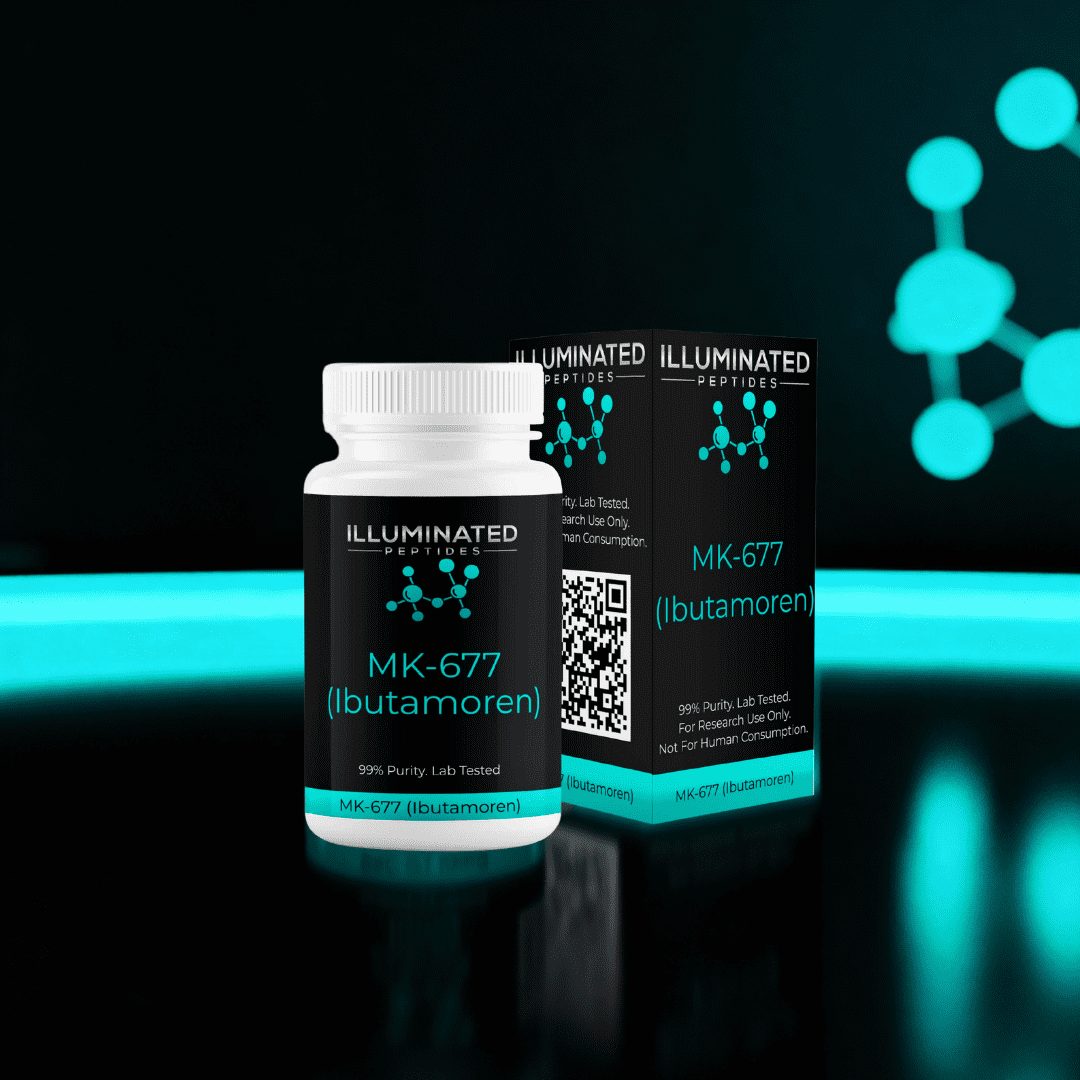
Description
MK-677 Overview
MK-677, also known as Ibutamoren, is an orally active and selective agonist of the ghrelin receptor. Research demonstrates that it increases the natural release of growth hormone while simultaneously elevating levels of insulin-like growth factor 1. Unlike many other compounds, MK-677 does not appear to significantly affect cortisol production, making it a focused option for growth hormone pathway research. Scientific studies have investigated its potential in addressing growth hormone deficiency, muscle wasting, and bone density loss. Preclinical findings also highlight its ability to stimulate appetite and regulate aspects of metabolism. In Alzheimer’s-related research, MK-677 has shown promise in delaying disease onset in animal models predisposed to amyloid beta accumulation. Another consistent area of interest is its influence on sleep, where improvements in both quality and duration have been observed. Together, these findings make MK-677 a widely studied compound for its diverse physiological effects in experimental settings.
MK-677 Structure
Molecular Formula: CHNO,S
Molecular Weight: 528.7 g/mol
PubChem CID:9939050
CAS Number: 159634-47-6
Synonyms: MK-0677, Oratrope, Ibutamoren, L-163,191
MK-677 Research
MK-677 and Somatopause
Somatopause refers to the gradual decline in growth hormone (GH) and insulin-like growth factor 1 (IGF-1) levels that typically occurs with aging. This natural reduction is associated with changes in metabolism, body composition, and energy balance. Because MK-677 acts as a ghrelin receptor agonist that stimulates endogenous GH release, researchers have studied it as a model compound to better understand interventions for age-related hormonal decline.
By mimicking the body’s natural ghrelin signaling, MK-677 has been observed in studies to restore GH and IGF-1 levels closer to those seen in younger physiology. This has positioned it as a valuable research tool for exploring how GH modulation might offset some of the biological changes linked with somatopause.
MK-677 and Body Composition
One of the most studied aspects of MK-677 is its impact on body composition. Growth hormone and IGF-1 are known to influence muscle protein synthesis, fat metabolism, and energy balance. Research shows that MK-677, by elevating these hormones, has been associated with measurable shifts in body composition profiles in both animal and human studies.
In controlled trials, subjects administered MK-677 demonstrated increases in lean body mass over time. This effect is thought to result from enhanced protein retention and greater activation of muscle repair and growth pathways, which are normally supported by GH and IGF-1 activity. Importantly, these studies emphasize that MK-677 achieves this without the need for exogenous hormone injections, instead stimulating the body’s own hormone release.
Alongside muscle-related effects, MK-677 has been studied for its influence on adipose tissue. Findings suggest it may support fat metabolism by shifting the balance toward increased energy expenditure and improved lipid turnover. These effects, while variable, add to the interest in MK-677 as a compound for metabolic and body composition research.
Additional work has examined how MK-677’s appetite-stimulating effects interact with its influence on lean mass. Because ghrelin receptor activation naturally promotes hunger, MK-677 has been noted to increase food intake in some studies, which may alter body composition outcomes depending on diet and activity level. This dual role of increasing both appetite and muscle-supporting hormones provides a complex but valuable area of investigation.
Overall, MK-677’s relationship with body composition highlights the broader connection between hormonal balance, metabolism, and tissue maintenance. The consistency of results across different study designs continues to make it a focal point for researchers interested in muscle, fat, and metabolic health.
MK-677 and Bone Density
Bone mineral density naturally declines with age and hormonal changes, contributing to frailty and fracture risk. Since GH and IGF-1 play a role in bone remodeling and turnover, MK-677 has been investigated for its potential to positively influence skeletal health.
Clinical research has shown that prolonged administration of MK-677 can increase markers of bone formation. These observations suggest that stimulating endogenous GH and IGF-1 may help support bone remodeling processes, making MK-677 a useful research compound for understanding bone physiology.
Although long-term outcomes remain under study, current findings suggest MK-677 may be particularly relevant in age-related bone density decline, offering insights into how hormone modulation impacts skeletal strength and resilience.
MK-677 and Neurological Function
The ghrelin receptor system is not only involved in metabolism but also plays a role in brain function. MK-677, as a ghrelin receptor agonist, has been evaluated in preclinical and early clinical studies for its potential influence on neurological processes such as memory, cognition, and neuroprotection.
Animal models of neurodegeneration, including Alzheimer’s disease, have shown encouraging responses when MK-677 is administered before significant amyloid beta accumulation. Findings include reduced neuronal stress and improved behavioral markers of learning and memory, which are thought to be mediated by both GH/IGF-1 and ghrelin signaling pathways.
While human trials remain limited, these preclinical results position MK-677 as an important research tool in exploring the links between hormonal pathways, brain plasticity, and neurodegenerative disease progression.
MK-677 and Sleep
Sleep quality is another area of interest in MK-677 research. Growth hormone secretion is naturally tied to sleep cycles, particularly deep slow-wave sleep, and compounds that increase GH may also influence sleep architecture.
In several studies, MK-677 has been associated with improved sleep duration and depth. These findings suggest that its effect on GH release could contribute to better restorative sleep, which is critical for tissue repair, cognitive function, and overall physiological regulation.
MK-677 and Heart Health
Growth hormone and IGF-1 signaling have important roles in cardiovascular physiology, including vascular tone and myocardial function. Because MK-677 elevates these hormones, researchers have investigated whether it might influence cardiac performance and vascular health.
Preclinical data suggest possible benefits in maintaining heart muscle structure and improving circulation, though results vary depending on study design. Clinical evaluation remains at an early stage, with ongoing interest in how GH secretagogues like MK-677 could impact long-term cardiovascular function.
MK-677 Summary
MK-677 (Ibutamoren) is an orally active ghrelin receptor agonist that stimulates the natural release of growth hormone and IGF-1. Unlike exogenous hormone therapies, it works by activating the body’s own pathways, making it a unique compound in hormone research.
Studies across animals and humans have consistently demonstrated its potential to influence body composition, bone health, neurological function, and sleep quality. These diverse effects are tied to its central mechanism of enhancing GH/IGF-1 signaling, which plays roles in growth, repair, and metabolic regulation.
Its influence on appetite, energy metabolism, and cardiovascular physiology further extends the scope of research into both short-term functional outcomes and long-term health markers. While not approved for medical use, MK-677 continues to attract significant scientific interest due to its wide-ranging effects.
In summary, MK-677 serves as a powerful research tool for understanding growth hormone biology, somatopause, and related aspects of aging and metabolism. Ongoing studies aim to clarify its full range of physiological impacts and safety considerations in diverse populations.